Sunday, June 10, 2012

For Corpus Christi


Once again from the archives, and a foll-up to yesterday . . . 

+++++

I wrote yesterday about the dignity and value that God assigns human sexuality precisely because of its capacity to reveal love as the self-same reality expressed by Jesus Christ on his Cross.  The mutual self-giving of a married couple is a sign to the rest for the Church of God’s love for us.  The love that is expressed by married people in symbol is the love the each of experiences in reality upon worthily receiving the Eucharist.

The parallels between marriage and the Eucharist are abundant and beautiful.  In the marriage bed, the bridegroom offers himself to his bride in complete surrender to her.  On the bed of the altar, the sacrifice of Calvary is made present to the Church once again, and Christ, the bridegroom, offers himself to his bride, the Church, in complete surrender.  In the context of marriage, the flesh of the groom and the flesh of the bride comingle so as to create a single body.  In the Eucharist, the flesh of the Christ enters into the flesh of his bride, the Church, as we literally consume his body and blood Sunday after Sunday.  This mutual act of giving creates life for the married couple.  In the Eucharist, we, as the bride of Christ, receive new and refreshed divine life within ourselves. 

As with love, the consequences of sin are similar in marriage and in our relationship with God.  In marriage, to properly love requires fidelity.  How can a man, cheating on his wife, offer himself to her completely and with surrender?  Each time he offers his body to her, he tells a lie to her.  If she is cheating, by receiving him, she tells a lie with her body.  Their infidelity is destructive to bride and groom alike, and they fail to serve as the image of Christ’s love to the world.  So too in our relationship with Christ – a relationship mirrored by marriage – do we do serious damage when we receive our groom unfaithfully.  Every time we receive the Holy Eucharist knowing that we are guilty of mortal sin, we tell a lie.  We are saying that we are in communion with out groom, Christ himself, and that we are in communion with the Body of Christ, the Church.  The fact is, however, that our sin has of necessity separated us from union with God and His Church.  We have been an unfaithful spouse, and we are in desperate need of reconciling ourselves so as to return to communion.

Luckily for us, to be restored to communion with Christ and his Church is much easier than healing a marriage that has experienced infidelity.  Christ, who is infinitely forgiving, invites us to that experience of his love, his forgiveness, and restoration through the sacrament of reconciliation.  There is a catch, though.  We do not get to decide the terms upon which he forgives us.  We do not simply get to say that I have asked Jesus for forgiveness in my heart, and he has forgiven me.  Christ himself decides the terms of our forgiveness, and he has been very clear about it.  If we are to be restored to communion with him and the rest of the Church, we must go to confession when we sin.

Allow me, in this final paragraph, to be very clear about the constant teaching of the Church in this regard.  If one willingly and knowingly breaks any of the commandments or defies any clearly defined teaching of the Church, he has committed a mortal sin.  He has ruptured his union with God and with the Church.  While suffering under the burden of this sin, he is not free to receive Holy Communion, and commits further serious sin if he does so, until making a good confession.  Stop cheating on our Groom.  Go to confession.  Get right with God.  Get right with the Church.  

Saturday, June 9, 2012

Apologia for Theology of the Body


Yet another . . .

+++++

Given its misrepresentation in nearly every facet of our oversexed society, it is imperative that Catholics have a firm grasp of the basic teachings of the Church regarding human sexuality.  Unfortunately, many assume that sexuality, according to the Church, can be summarized in a single word: “No!”  In truth, though, the Church believes human sexuality to be a beautiful gift from God through which humans are permitted to express the reality of having been formed in God’s image and likeness.

Catholic teaching on sexuality is rooted in our understanding of the Holy Trinity.  God the Father, God the Son, and God the Holy Spirit love one another with an incredible intensity.  As the Scriptures say, “God is love” (1 John 4:8).  There is nothing squishy about this love.  Rather, their love constitutes an eternal relationship of self-gift, wherein they pour themselves out for the sake of the others.  The manner in which they love manifests itself to the world is Christ’s gift of himself for mankind in his death on the Cross.  Human sexuality becomes the physical means by which men and women exhibit the same qualities of love in their own lives, and thereby participate in the very mystery of God’s creative love.

The love Christ demonstrates on the Cross is characterized by four distinct but related elements.  First, his love is free.  As he relates in the Gospels, “No one takes my life from me.  I lay it down freely” (John 10:18).  So too must sexuality be an expression of freedom in which both partners willingly offer themselves for the sake of the other.  Similarly, Christ’s love on the cross is total and complete.  He reserves no part of himself for himself.  He gives everything even unto death.  So too must a couple be willing to reserve nothing to themselves in their sexual relationship.  They give their very bodies to the other for the sake of the other.  They hold nothing back, even offering with trust their own fertility and the possibility of the sacrifice accompanying a pregnancy.  Moreover, Christ’s love is faithful.  He will not go back on his promise.  He will not renege on his gift.  As the scriptures say, “Even if father and mother forsake you, I will not abandon you” (Psalm 27:10).  His gift for us remains, even when we are unfaithful to him.  In sexual union couples promise the same.  Their bodies declare that they will love one another even to the point of death -- even when one of the partners no longer deserves such love.  Finally, Christ’s love from the Cross is fruitful.  It gives life.  It opens to us the possibility of eternal life.  Human sexuality must do the same.  It gives life to the partners, as opposed to taking from them.  This life-giving quality is expressed most especially when the conjugal union results in the conception of a child.  

Given these qualities, it becomes clear that only one appropriate context for such love exists.  In marriage, couples promise each other in front of friend, family, and God Almighty, that their union will be permanent and exclusive so that each may give him or herself to the other freely, faithfully, fruitfully, and totally.  It is also clear, from what is described above why such things as pornography, masturbation, and artificial forms of contraception, constitute a serious sin.  They become acts of selfishness wherein, rather than giving, a person takes from the other.  They separate the essential qualities of union of partners from fruitfulness.  They make the means by which humans are most like God into an animalistic ritual.

What I have written above is only the briefest of summaries of the Catholic tradition regarding human sexuality.  The topic is covered much more thoroughly and eloquently in the exposition of the Church’s teaching by Pope John Paul II.  This exposition is popularly known as The Theology of the Body.  At Blessed Sacrament we introduce this material to students in eighth grade.  Regrettably, most parents do not have the context by which to reinforce this teaching at home.  It is my prayer that each of you will make a sincere effort to learn more thoroughly God’s astonishingly beautiful vision for human sexuality.  
 

Friday, June 8, 2012

Why Am I Catholic?


This is another from my series of bulletin covers. It might be interesting for you to try to respond to the questions I present in the comment box.

+++++

Two young men with whom I am fairly well acquainted recently honored me by asking me to serve as their sponsors for the Sacrament of Confirmation. Though I was surprisedby these two invitations, I was quick to accept. After all, in what way could Ibetter use my time than assisting these two teens as they prepare for the final step of their full initiation into the Church, and in some respects, as they make a significant step toward full-fledged manhood? I am eager and excited to be a part of this process, and I look forward to the opportunity to meet regularly with them, and to watch them grow in faith and in charity throughout the course of the next several months. In a particular way, however, I am most eager for them respond to this question: “Why does it matter that I am Catholic?”

This question, it seems to me, pierces directly tothe heart not only of our identity as Catholics, but ultimately, to our identity as human beings. To describe why I am Catholic means that I must take into consideration what I believe about God, what I believe about human life, and how I understand my own existence in this universe. To say why I am Catholic is, fundamentally, to try to articulate the fundamental principles upon which I believe the rest of reality rests. So, perhaps the shorter way of saying all of this is simply to posit that it is not accidental that I am Catholic; it is the most important fact about my life.

"You are Peter, and upon this rock I will build my Church, and the gates of Hell shall not prevail against it. I will give you the keys to the Kingdom of Heaven. Whatever you bind on earth shall be bound in Heaven; whatever you loose on earth shall be loosed in Heaven." - Matthew 16:18-19
Having opined with such force on this matter, I would be remiss to not offer, albeit briefly, some explanation of why I am Catholic. First, I believe that God exists, that He always has existed, and always will. His existence is mysterious; he is both three and simultaneously one. For God to be is the same as for God to love,and out of that love, man first came into being. Man, out of all of creation, was and remains the pinnacle of God’s creation. Man is the most beloved of all the things God ever made, but man, in his pride, rejected that love, introducing both sin and death into the world. God, for His part, never stopped loving man, and when the time was right, God became a human to redeem man and to restore him to the full dignity with which he was first endowed at the moment of his creation. Jesus Christ reveals to humans what it is to be a human being, and he opens the means by which all the rest of humanity might become like him. We most readily access these means through the visible institution of the Catholic Church. In a word, God, through the Catholic Church, shows me who I am, who I am supposed to be, and the manner by which I can become who I am supposed to be. No other tradition answers the basic questions of my existence quite as thoroughly as does the Catholic Church.

In the coming months, I hope that the two boys I am sponsoring will arrive at similar answers for themselves, or at least that they will begin to find similar answers. I will be working to help them come to these realizations. As I do so, I will also be asking this question of myself in a new way. I hope that just as I am doing this, so will each of you. Why are you Catholic? Why do you come to Mass each weekend? Does it make a difference? Would your life be different otherwise? This is a question that can change your life.

Thursday, June 7, 2012

A Summer Reminder


One of the reasons that my writing has been more sporadic during my tenure at Blessed Sacrament has been the fact that I have been writing for the cover of the bulletin every few weeks.  As a way of preserving those covers for future use, I think I will publish the better ones here.

+++++

In the Church, there exists a long and venerable tradition of hiding from view what is most sacred and mysterious.  The tradition has Biblical roots.  Moses covered his face when encountering the Lord, and later, after his own face was transformed and radiant after another encounter with God, he veiled it when speaking to the people.  Likewise, when God delivered his commandments to Moses, he wreathed the mountain in smoke.  Similarly, when addressing his people through Moses, he appears only within the tent erected to house the Ark of the Covenant.

Many older Catholics will also recall a time when the tabernacle in the Church, in which any remaining consecrated hosts are reserved, was covered with a veil.  They will also likely remember a time when the chalice and patten (the vessels in which the bread and wine are consecrated to become the body and blood of Christ) were covered with a veil from the beginning of Mass until the beginning of the Eucharistic Prayer.  These customs are still practiced in some places.

In each of these cases, such covering existed not to suggest that the eyes of common people are profane, or that “normal people” are unworthy to gaze upon beautiful and holy things, but rather, to remind us of the sacredness of that which was covered.  To veil a tabernacle or a chalice reminds us that the objects upon which we look are not ordinary and destined for pedestrian uses.  Rather, they are integral elements of something altogether otherworldly, but which God, in his profound generosity, has given us permission to approach.  To cover or veil something reminds us that the thing that has been covered is holy and must be approached and handled with the great respect and reverence due to it.

 It is for this same reason that we should all strive to practice the virtue of modesty in our dress.  The human body, created in God’s image and likeness, is endowed with dignity and is profoundly sacred.  It is in the body that one lives one’s life and progresses toward holiness.  It is in the body that one receives God’s grace through the sacraments.  It is with the body that husbands and wives, in imitation of Christ’s self-gift on the Cross, give themselves completely, freely, faithfully, and fruitfully to one another.  It is in the body, that these same husbands and wives demonstrate the mystery of the union of the three persons of the Holy Trinity, and it is in the body that they becomes signs of the love that Christ has for his Church.  The human body is sacred and mysterious.  It is not meant to be shown and flaunted to all who care to look.  As with a chalice or tabernacle, it should only be uncovered at the right time, by the right person, and under the right circumstances.

The consequence of this fact should lead us to a rather obvious conclusion.  We, men and women alike, should not attire our bodies in such a way so as to draw unseemly glances from others.  We should not clothe ourselves so as to suggest that our bodies exist as an object to be used for the pleasure of others.  We should not dress so as to lead anyone to believe that our bodies are anything less than the most sacred gift God has deigned to give us.  Likewise, we should be vigilant in assuring that our children, especially teens, do none of these things.

To be modest, does not require that one have no taste.  Modesty and class are complimentary.  Modesty does demand, however, that we acknowledge that the human form is beautiful, sacred, and mysterious.  We should never allow anyone, ourselves included, to approach it with anything less than the absolute reverence it deserves.


Monday, June 4, 2012

Marriage and the Holy Trinity


While still Josef Ratzinger, Pope Benedict wrote in his book The Spirit of the Liturgy, "Wherever applause breaks out in the liturgy because of some human achievement, it is a sure sign that the essence of the liturgy has totally disappeared and been replaced by a kind of religious entertainment."  This quote came quickly to mind on Saturday evening and Sunday morning as applause broke out in the Church while I made my way back to my chair following my homily.  I was embarrassed.  I do not preach for applause or other accolades.  I preach the readings, and sometimes I say things because they need to be said.  Because I am not in the habit of writing my homily prior to delivering it, in what follows I submit a written version of what I preached for Trinity Sunday.  It is not a transcript, but I intend to be as faithful to what I said as possible.  I do so only inasmuch as a number of people have asked me to write it, and it is easier to send them here than to send a copy to them by email.

+++++

In Catholic teaching, we sometimes use the phrase "sacramental economy" which bears a bit of explanation.  The word "economy" is derived from a Greek word, which originally was associated with the ordering of one's household.  It was had to do with the manner in which one would organize one's slaves and laborers and the like.  The word implies something ordered and systematic.  We should also be reminded of the meaning of the word "sacrament."  Those who were catechized by means of the Baltimore Catechism would quickly tell me that a sacrament is an outward sign of an invisible reality instituted by God to give us grace.  A shorthand way of saying this is that a sacrament is a visible sign of invisible grace.  Thus, when speaking of sacramental economy, we are describing the manner in which God has created the world so as to communicate something about himself.  Another way to think of this is to say that when God created the world, he left his fingerprints all over it.  For example, in the transition of the seasons from spring, to summer, to autumn, to winter, and back to spring, we see something of God's eternity.  He is without beginning or end; He always has been and always will be.  Similarly, that we see plants die and the world go dormant each fall only to return to life in the spring reminds us of God's promise of resurrection; death is not the last word in life.

Today we celebrate the mystery of the Holy Trinity.  This mystery is the central mystery of Christianity.  As Christians, we profess that our God is Three Divine Persons, Father, Son, and Holy Spirit, each distinct and yet equal in dignity.  And yet, even though distinct from each other, these Three Persons are One.  Our God is One in Three, Three in One.  Moreover, we believe that from eternity, God the Father has been begetting God the Son, and in return, God the Sun has been offering Himself back to the Father.  Another way of saying this is that God the Father has loved God the Son with the deepest intensity, and God the Son has loved God the Father with an equal intensity.  This love between the two of them is so profound that it takes the form of a third person, God the Holy Spirit.  This reality is a mystery in the truest sense of the word.  Though we can understand it in part, we will never plumb the depths of the Holy Trinity.  God, however, has always desired that we should know him.  As a result, within human life, he has given us an experience that mirrors the reality of God's love within himself.  This reality is holy matrimony.

It works like this: Within marriage, a man falls in love with a woman, and he loves her more deeply than he has ever loved another person.  Likewise, the woman falls in love with the man, and she too has never loved so deeply,  The love between the two makes them one, and the love they share actually manifests itself in the conception and birth of a child.  Family life is something of a mirror for the reality of God's love within Himself.  It is for this reason that no Catholic in good conscience may support any effort to define marriage as anything other than the permanent and exclusive union of one man and one woman for the entirety of their lives together.  Simply stated, the union of two males or of two females cannot express the mystery of God's love in the way that the union of one man and one woman is able to do.

The Holy Trinity is the foundation of all of reality.  Everything we experience in life, we experience precisely because of who God is.  Life as we know it would be altogether different if God were different than he is.  Likewise, because He is foundational to existence, marriage, the institution by which we recognize something about God, is also foundational to the human experience. Human society and culture are precipitated upon the existence of marriage as it has always existed.  Without the coupling of man and woman, we would have no culture, we would have no society, we would have no nation.  Marriage and its ensuing family provide the context out which all of these elements of human existence are born.  As a result of this, we must admit that there is no such thing as marriage between two men, and their is no such thing as marriage between two women.  They are incapable of accomplishing the ends for which marriage exists.

At this point a caveat must be made.  Mother Church does not hate men or women who possess this inclination.  She loves them as much as she loves any of us.  Nor must we say that two men or two women are incapable of great affection for one another.  We might even admit that what they share is a form of love.  Allow me to be very clear, however:  This form of love is not the kind of love that reflects the reality of the inner life of the Holy Trinity.  By its very nature, unions between two persons of the same gender are incapable of becoming this sort of sign to the rest of us.  

Because of the weight and value of marriage, because of the role marriage plays in helping us to understand God properly, it becomes incumbent upon every Catholic to do all within his power to resist whatever efforts are made to redefine or damage the institution of marriage as humanity has always known it.  It is equally pressing that we do all within our power to defend this institution.  Marriage is not simply a civil right.  It is not simply a social institution.  It is a union established by God Almighty, and it is not within the realm of our authority to redefine it or to try to make it something other than it is.  This is not a matter about which we can choose to be ambivalent.  Because marriage rests at the core of our society, and to change how we understand the nature of that union must necessarily affect how we perceive everything else, and most especially how we perceive God Himself.  Catholics must take a stand.

The Holy Trinity has existed from all eternity as a communion of love.  This love is deeper than any we can expect to experience in this life.  And yet, because of the union of man and woman in marriage, we know something of this Divine Communion into which we have each been invited by virtue of our baptisms.  If we are to properly know this God who is love itself, if we are to properly understand who we are in relationship to God whose very existence is a union of persons, marriage must stand and must be defended.  It rests upon our shoulders to do so.


Wednesday, May 30, 2012

Baseball is a Catholic Sport

I find that in large and small ways I am a man of routine. I was once told that a person ought to switch to a new brand of antiperspirant every few months. I've used the same brand for years, and always approach the aisle at the store fearing that it will no longer be available. I do not switch the ring tone on my cell phone. Having once set the background picture on my computer, it is likely that it will remain the same for the duration of my association with the machine. I take the same route to and from nearly everywhere I drive with any frequency. Likewise, I find that for three years of priesthood, I have done largely the same things in each season. Right now, we are in the midst of my trout season. I caught a lovely rainbow last night. Trout season, however, is interrupted by baseball.

I have written before that I am not a baseball player, and until I discovered that boys in my parish were on a variety of baseball teams, I had no intention of becoming a baseball fan. As it were, going out to support the kids of my parish has led me to a place where I am able to say that I rather like baseball.

The baseball team from the local Catholic High School participated in the state tournament on Monday. I drove, accompanied by the father of one of the players, to watch the games. We arrived late Sunday night, and after I spent the next morning with a young priest friend in Sioux Falls, we headed to the ball park. The first game was truly artful. Three errors by the opposition in the first inning led to two runs for our Cavaliers. Our team made no errors, nor did the opposition for the remainder of the game. High school games last only seven innings, and by the end of the seventh, the score remained the same as at the end of the first. Our boys would progress to the championship game. Lunch, two beers, and a nap later, we found ourselves once again removing cover to honor the flag and the fallen, then, "Play ball!" The game was heart-wrenching. Our boys led seven to four until the sixth inning. The opposition made a major comeback, and finally won in extra innings on a walk. That one of our players received the award for tournament MVP was of little consolation. Baseball is a fickle sport, and in in the final hour, her favor had abandoned our team. As we made our back toward Rapid City that night, the player in my back seat was distinctly unpleasant. His father and I both sighed in relief when he finally fell asleep. I was not in bed until around 2:00 AM. Was it worth it? Most certainly.

The crack of the bat, I have often remarked, speaks deeply to the American psyche. Baseball is rooted deeply in our American identity. It figures largely in our history. These are reasons enough to like the game, I suppose. In addition, however, baseball, more than other sports, speaks to our conviction that no matter how bad things get, they can always get better. Baseball is a Catholic game; no matter how recalcitrant the sinner, we believe, he can always be saved. Regardless of how deeply rooted the sin, it can be converted. So too with baseball - one good inning changes everything, and it is not over until it is over. We can generally predict the winner of a basketball or football game by the end of the third quarter. Wouldn't it be awful if the same were true of us as humans, that by the time we have turned fifty, everyone has given up hope that we can still change trajectory?

Baseball, it turns out, makes me rather hopeful. Even when we lose, there is always next year. For now, there are still lots of trout to be caught. In a few months there will be pheasants to be shot. A bit longer, and a winter to be endured. And then baseball again. Maybe next time we will win. Maybe next time, I will be holier. Maybe next time . . .

Thursday, May 10, 2012

Dzoti

I ran out of clean clothes three days ago. By this time tomorrow, I will have also run out of axe body spray, which has served as my substitute for a washing machine. I fear I may be going native.

Early Tuesday morning (5 AM early) the other fathers and I shoehorned ourselves, our luggage, and the breakfast Mamma Garbacz had packed for us, back into Bart's car for our commute to Krakow where we were to board a plane for a one hour flight to the North of Poland. This was to be the first step in accomplishing the second major goal of our Polish pilgrimage: to see Jody, (or as her sisters call her, Dzoti) Sowers, a postulant in a religious community here.

The drive was relatively uneventful, and after leaving the larger portion of our luggage in Fr. Pawl's care, we were at the airport. In typical fashion, we were treated like cattle and variously violated by the Polish version of TSA before wandering into a grey metallic sort of holding area. The flight left on time and landed at our destination on time. We waited briefly before we were collected by a representative of the car rental company. His arrival heralded what would ultimately become the most harrowing leg of our journey. Americans, aside from participants in demolition derbies, are not well suited for European driving. Fr. Tim's anxiety was palpable. Fr. Marcin's hurried instructions from the passenger seat bore a constant sense of strain. My feverish recitation of the Act of Contrition from the back seat did little to ease the tension. The whole enterprise seemed to be summarized as we tried to gain access to the expressway by Fr. Tim's almost despairing declaration, "Oh God! We have to merge."

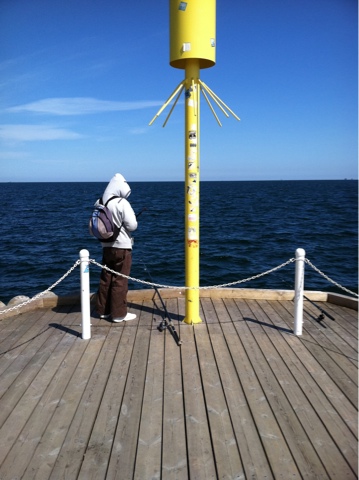
By the grace of God, we safely made our way to the seaside town of Sopot. A short expletive filled adventure on the round-about eventually led us to the parking garage. From there a brief walk brought us to the shore of the Baltic Sea. The nausea inducing fear of the drive having passed, we decided it would be wise to eat. The first open restaurant sold fish, so we decided to sample the local seafood. It was huge and delicious (see the picture below). From there we walked the long wooden dock (the longest in Europe in fact) out into the sea and enjoyed the sun on the benches overlooking the marina. We tried to avoid having to look at the various mostly nude European sunbathers. I considered taking pictures to post here so as to deter any would-be nudists reading this post, but I was afraid doing so would only prompt the fleshy monsters to disrobe further.

Swans, a replica pirate ship, a Polish fisherman, and more amber and coral jewelry that I had ever seen before dazzled us until we finally headed back to our little car for the last leg of our journey to see Jody. A short drive, a brief argument, and a couple of near death experiences later, and we found ourselves at the convent hugging and laughing and very glad to see a radiant looking Jody. Convent life suits her well.

As with all places Polish we were forced to eat. And then eat some more. After the meal we were shown our rooms and then made our way to the chapel for Marian Devotions and Mass.

The sisters have their own chaplain, Fr. Edwin, who lives in a private apartment within the convent. He provides daily Mass and fulfills other priestly needs. In return he is provided with meals, lodging, and free housekeeping. Fr. Edwin has been with the sisters for fourteen years. This assignment suits him, as he is a sickly man who receives dialysis twice each week. Unfortunately, Fr. Edwin is also a bit odd and an exasperatingly long homilist. Given that it takes three times longer to say in Polish anything that one might say in English, and my disdain for rambling homilies, it was pure agony as Fr. Edwin laboriously recited details of the life of the foundress of the order to the sisters and their lay guests that evening. Already exhausted and curious to hear more of the details of Jody's life, I just wanted Mass to end. Finally Fr. Edwin prayed the closing prayer and offered a relic of Mother Foundress for veneration by those present. As the sisters approached in procession to do this, Fr. Edwin waved at us as though shooing us away. I was rapturous until hearing what I will remember as the saddest words of our trip. "Don't leave! We are not finished yet." Father was just asking us to be seated. God forbid we depart before he stammer his well wishes and greeting to us in English.

Mass finally did end. We met Jody's Polish Language Instructor. We had drinks with Fr. Edwin in his apartment. And finally we slept, though not without arguing with Jody about whether we American priests would celebrate Mass with the community or at another time the following morning. I am pleased to report that Jody has already mastered the nunnish skill of bending priests to her will. Painfully early the next morning, we once again found ourselves listening to the droning homily of Fr. Edwin.

The early morning was soon forgotten. We shared breakfast with Jody, the other postulants, the novices, and the novice mistress. This was a particular privilege, as these young women are generally sequestered from the remainder of the community and visitors for meals. Given that we were priests, however, and the peculiarity of Jody's situation as the only American to have ever joined the Order, we were given permission to eat with them in their dining hall. Of note at this meal were sausages made of wild boar. Following the meal, the sister-to-be was given permission to leave the convent under the supervision of her priests for the day. And what better place to take an aspiring nun than a medieval castle established by a Holy Military Order only to be routed by the selfish Poles in 1410.

Arriving at the castle required more driving adventures, including a demonstration on how to pass in oncoming traffic. Upon arriving in Malbork, home of the castle, Jody requested that we stop at McDonalds. She had not eaten American food of any sort for a year. Fr. Marcin and I were glad to accommodate her, as we had been without Internet access for a full day and were in need of a fix. We spent a bit of time sitting in the square watching the fountain after satisfying our craving for the Golden Arches, and finally, we ascended the hill leading to the Castle.

Malbork Castle is comprised of three sections, all connected, sitting on forty-six acres. To enter the innermost section of the castle, one must pass through six gates, one of which is a functioning drawbridge across a moat. Within the castle is space sufficient to house an army and its horses, servants, and supplies to last a siege of three months. For the centuries during which it was a functioning castle, the walls were never breached.

Within the castle was an outdoor prison, functioning water fed latrines, the quarters of the grand master of the order, a church, dining halls, and everything necessary to support the residents and staff. The building is built of red brick, much of which was reconstructed by preservationists following WWII when axis troops took refuge in the castle and prevented Stalin's troops from progressing further toward Berlin until the evacuation of that city could take place. We saw pictures of the damage. Unimaginable.

Stopping in the chapter room, where members of the order would have prayed the liturgy of the hours, we spent a good deal of time singing and playing with the acoustics of the chamber.

All in all, this place was incredible - Heating systems, wells, defenses, turrets, everything one hopes for in a castle. By the end of the tour we were exhausted and much in need of a good meal. Jody had turned 21 the day of our arrival at the convent, so that night she ordered a beer. She drank enough to taste and enjoy it before passing the mug to me. I enjoyed the rest on her behalf.

Returning to the convent we paused at McDonalds once again for an Ice Cream Shake, another request from the sister, and a brief email/facebook checkin. We all went to bed early and got up for one final convent Mass.

The city in which Jody's convent is located is quite unattractive in most respects, and suffers from the neglect of most small rural towns I have encountered. Undeterred by its post-communist accouterment, however, the city by reason of a shrine to St. Valentine, calls itself the city of love. (As a matter of curiosity, besides lovers, Valentine is also patron of the mentally handicapped. As Fr. Edwin noted before we left this morning, these two patronages are often one in the same.). As with the day previous, Jodi had permission to spend the morning with us, so we wandered to the shrine of St. Valentine hoping to see his severed head. We drew near, but the church is undergoing construction thus preventing us from actually seeing the head. I was deeply saddened by this. The others, making the best of a poor situation, decided to climb the Church's tower. I declined, choosing to recline in the door of the church instead. From the looks and what I was able to intuit from passersby, this is an activity generally reserved to drunkards and lepers. If I had set out a small cup, I might have collected alms.

From the church we wandered among venders in the market square, drank some coffee, and ate ice cream before winding our way back to the convent for lunch. The sisters, all fifteen of them, came to wish us well. We lingered over goodbyes, gave hugs for all who sent them, tried not to become tearful, and then reluctantly set out for the airport. I sit now, writing from my Hotel room, wondering how these days have all passed so quickly. By this time tomorrow, I will be nearly home.

So, in summary, Poland is amazing, Jody is doing swimmingly, and none of us has died, which is honestly more than I had hoped for (Mostly that none of us is dead. I had anticipated having to kill one or the other of my brother priests. We have all remarked about how successfully we have managed not to fray one anothers' nerves.). I will try later to give some spiritual insight into these last few days. For now, it is sufficient to say that as with my adventure last year, this adventure has given me some perspective and helped me to get ready to leave Rapid and head to Spearfish.

For now, enjoy these pictures.

Monday, May 7, 2012

My God, He Looks Like Churchill

I suppose that one could say that for the last few days I have been in rural Poland. After spending Friday morning exploring , during which time we visited the church where JPII was baptized, we bid farewell to Fr. Pawl and were driven by Fr. Marcin's brother Bart to his hometown. We arrived mid-afternoon, and having gone through the necessary hugging and greeting of the town's prodigal son, we set about sampling the various delicacies Fr. Marcin's mother had been baking from the moment she received word that we had touched down in Krakow.

Fr. Marcin's childhood home is an enchanting place. The house is three stories, with a kitchen and separate dining room consuming most of the main level and bedrooms and a den above. Behind the house lies a track of land about 100 yards in length that has been painstakingly converted into a garden over the years. Raspberries, apples, flowers and some vegetables grow in various plots around the area. To one side of the house are grape vines for wine making. Similar vines climb ropes to provide shade over the balcony outside the den in the summer. Having eaten and acquainted ourselves with our new environs, we all decided a brief nap was in order. We awoke in time to catch a ride to the parish church where we were entertained briefly by the pastor before vesting and joining the already assembled congregation for Marian devotions.

May is, of course, a month dedicated to our Blessed Mother. In the States this generally means that we do a May Crowning of Our Lady on the first weekend of the month and that perhaps school children and old ladies will occasionally bring flowers to leave near her statue. While admirable, these practices are only a shadow of what occurs in every pariah in Poland. Beginning May 1 and continuing throughout the month, people gather for Eucharistic Adoration every evening during which time they sing the Litany of Loreto and sometimes pray the Rosary. The devotion ends with the celebration of Mass.

Arriving in the sacristy, we were swarmed by servers (all boys) of varying ages who were instructed to help us vest. Like Mexicans laying shingles, these young acolytes had us all appropriately dressed in short order. When I say that they dressed us, I mean this quite literally. The priest stands in one place as the servers bring the vestments and place them on the priest.

We sat in the sanctuary throughout the devotions and then returned to the sacristy in order to process back into the Church for Mass. The Mass itself had only one server, Conrad, who must be about ten. While I intend no slight to our American servers, I am left to conclude that we expect entirely too little of acolytes in our own country. Conrad knew exactly what needed to be done and when to do it. He was attentive to the celebrant who had forgotten something in the sacristy and he was quick to obey the sacristan who called him back to the sacristy a second time to bring another forgotten item. Besides this, he was quick to show me all in gestures where to go and what to do as I helped distribute Holy Communion - an experience a bit like one imagines a run on the bank after the stock market collapse of 1929.

Following Mass we joined the pastor and his four associates for a light dinner. Walking home we stopped for coffee and ice cream. We watched a video on Fr. Marcin's computer, cursed the spotty wireless connection (which is why I did not post earlier) and then went to sleep so as to be fresh for the main event of our visit. Fr. Marcin's oldest niece was to receive her first Holy Communion on Sunday morning.

First Communion is a big deal in Poland. The church was decorated beautifully. In all, eleven priests concelebrated the Mass. Most were from this parish originally and were there to witness relatives receive the sacrament. The children were dressed all alike in white albs. The girls had light blue trim on their garments while the boys' albs were trimmed in red. Most of the girls wore a white fur trimmed shoulder cape and a crown of flowers. If my memory serves me, 154 children received First Holy Communion. This was a small class we were told later. The children approached the altar two by two and knelt at a kneeler placed at the front of the main isle where they received the Eucharist on the tongue. In Poland it is not customary for the laity to receive the Precious Blood, nor, I think, would it be practical. The people in attendance were so numerous that they spilled out the doors into the courtyard.

While awed by the faith, devotion, reverence, and traditions of these people, I found myself feeling a little homesick. I wanted to be among me own people greeting them, teasing my servers, and hearing confessions. It is good to get away and it has been a marvelous trip to date, but in that moment, I longed to be home.

With Mass completed, and the twenty some servers having helped us remove our vestments we were ready to return to the house for an enormous lunch. The table was crowded, the family was loud and happy, and I was longing for an excuse to be alone. Having politely eaten like a pig, I excused myself and made my way to my room for a lengthy nap. When I arose, I made my way downstairs where the crowd had dissipated only slightly, and where most people were still eating. Astonished, I meandered to the balcony off of the dining room to enjoy an afternoon cigar. I was there only a few minutes before Fr. Marcin emerged giggling. His Godmother, having glimpsed me through the window had announced, "My God. He looks like Churchill!" There are worse people to look like I suppose.

The entire evening was dedicated to a discussion of the state of the Church and the state of the State in Poland. I have a great deal to say about the former, but that is for another post. For now, I conclude with these observations:

1) Brothers are much the same regardless of where they are from. Seeing Fr. Marcin with his brothers makes me miss my own.

2) I want to take Conrad home with me. Shy and precocious, I am now terribly curious about him, and frustrated that I haven't the language to speak to him.

3) Priests are good men. While my life and the lives of the priests here are wildly different, we still speak the language of common experience - baptisms, Mass, confessions, and the like. We share a fraternity not to be found elsewhere.

4) I shall always be an introvert. Loud crowded tables exhaust me, regardless of the language spoken by the guests therein.

5) I am deeply grateful to be an American and a priest, and I am grateful to be both in a place where I can fish. I hope I have enough energy to get out and get my line wet after driving back from Sioux Falls on Saturday.

Friday, May 4, 2012

Sometimes Wishes Do Come True

There can be no doubt that I am of robust proportions. Likewise, there can be no doubt that Europeans are rather scrawny folk by American standards. So, though disappointing, I was not entirely surprised to discover that the first store we visited today did not sell a cassock large enough for me. Almost, but not quite. Nor did the second store. Nor did the third. Oh well. I was prepared to abandon this project and was contentedly smoking a cigar in the park when Fr. Marcin emerged from one of the stores announcing that he bad arranged to have the tailor call us when he came to the store. Perhaps he would be able to altar a cassock to fit me, or even agree to make a custom cassock for me. With this promise we set out to do a bit of exploring of Krakow's underground. We wandered among a variety of vendor stalls and looked at the work of local artisans for a time. From there, we quite literally descended through progressively older layers of the city in order to visit a relatively new museum dedicated to the ruins beneath the modern city. I was tired and glad for the relative cool offered by a very interactive lesson on Poland's dark ages. Leaving the museum, we braved the rain to cross the square and pray for a while in yet another beautiful church.

We ate a mediocre lunch and then set about finding a tobacconist. These are few and far between in Krakow. Finding one had, until today, been much like the search for El Dorado. We found one, and after a dissatisfying selection in the humidor, we bought pipes and pipe tobacco hoping that these would remain our contingency plan. We once again set out looking for a store we had been reassured time and time again would be the fulfillment of our nicotine driven longing.

Just as this fulfillment seemed within our grasp, Fr. Marcin received a phone call. The tailor had arrived and would wait one half hour for us. What were we to do?

Fr. Marcin hurriedly made his way to the ground floor of the mall we were reconnoitering to hail a cab. Fr. Tim and I made a last ditch effort to find the golden city. All seemed lost when suddenly to our right loomed one of those horrific surgeon general's warnings about smoking. We had finally found it. It was a moment of great joy. Rapidly making our purchases, we rejoined Fr. Marcin above and arrived in plenty of time to order a cassock and arrange to have it brought to me. I was so pleased I insisted on a photo with the spritely tailor. Unfortunately, said photo is on Fr. Marcin's phone.

From there we drove like mad men to arrive at the Divine Mercy center in time to purchase several items from the sisters. All in all, through Fr. Marcin's inspired leadership, everyone's wish came true.

Late evening found us concelebrating Mass in Polish once again at the Church where the boy who would become JPII took Blessed Mary as his mother after the death of his earthly mother. This church, part of a Franciscan priory, sits atop a glorious hill. The view was astounding. After another twenty minutes of driving we managed to arrive in Wadowice, the hometown of JPII. We ate our best meal to date and finally met Fr. Pawl about whom Fr. Marcin has spoken incessantly for days. A couple of beers, a bit of whiskey and a cigar later, I find myself now trying to wrap up this post so I can sleep.

Day by day I am beginning to see why the Nazis wanted this country for themselves, and why countless generations if Poles have battled to the death to defend her.


Thursday, May 3, 2012

Mary, Queen of Poland

This week is a holiday week in Poland. Our arrival corresponded with the Feast of St. Joseph the Worker. In communist days this celebration was supplanted by the Marxist version of Labor Day. These days, the celebration of the working man remains but it has reacquired its religious significance. Today marks Polish Constitution Day, commemorating the promulgation of the Polish Constitution, which, as Fr. Marcin reminded us repeatedly, occurred prior to the full ratification of the American Constitution, even though ours had been written first. On this day the Polish also commemorate the day some 300 years ago when one king or another dedicated the nation to Blessed Mary as their queen. It is a civil holiday, but many choose to celebrate by attending Mass. We were among this group today who celebrated with the Cardinal Archbishop of Krakow.

I had met the Cardinal once previously when he introduced me to Pope John Paul II in a visit to Rome with classmates, so I was quite put out that he failed to remember who I was. Aside from this, however, it was an extraordinary celebration attended by the military who made quite a scene when they marched into the Cathedral. It was also attended by the royal family who were attired in furs and pheasant feathers and some fellow who wore a full suit of armor. As I was vested and at the altar I was unable to take photos of them.

Following Mass when climbed a steep narrow set of steps to view the largest bell in continental Europe. The only larger bell is Big Ben. In the end it was worth the climb, but the daunting thought of ascending a bell tower was attractive to only one member of our party. I will give you a hint: he was not an American. From the tower we descended into the crypt to see the sarcophagi of long dead kings. The highlight of this expedition was viewing the Altar of St. Leonard at which John Paul II celebrated his first Mass after ordination as a priest. Climbing one more set or stairs, we emerged into the main body of the Cathedral and surreptitiously took photos of the tomb of St. Wenceslaus.

Lunch, and a nap consumed the afternoon and in the evening we visited the Divine Mercy Sanctuary. The architecture of the building in modern, as is the decor. It remains, nevertheless, beautiful and inspiring. We were led on a tour by the rector of the facility before finally pausing to pray at the tomb of St. Faustina and the Divine Mercy image.

We have returned to the hotel after a lovely evening to rest before doing some shopping tomorrow. We travel to the hometown of JPII tomorrow evening and to Fr. Marcin's hometown the day after for more Polish adventures.

Wednesday, May 2, 2012

Auschwitz

After arriving, checking into the motel and showering last night, we went out for a good Polish meal. This was superb, and as we meandered back toward the car, we laughed, and joked, and savored the cool evening air - we had been breathing fake airport air for nearly a day. Apparently we made quite the spectacle, because we were solicited by three separate prostitutes. They didn't believe us when Fr. Marcin told them we were priests. Our young Polish hosts decided that they needed to go out with priests more often. Eventually we arrived back at our hotel (unaccompanied by ladies of negotiable affection) and had a short sleep before leaving early this morning to experience Auschwitz and Birkenau.

In five years, these two camps exterminated nearly two million people, most of whom were Jews. I have seen such efficiency in only one other place- a beef slaughter house. The camp, with it's famous sign mocking those who entered with the promise of freedom gained by work, was the most efficient industrialized complex for the slaughter of humans man has ever known. And it made money.

Prisoners were shaved after death so that the hair could be sold for profit to textile factories. Silver and gold was collected from teeth. Certain Jews were made to pay for their train ticket to the camp, thinking that they would find a better life after leaving the train. Children's shoes were taken from them before entering the "showers" so that they could be sold to Nazi families in Germany. We passed through a room literally filled with the hair of victims that had not been shipped prior to the liberation of the camp. Other rooms were filled with suitcases. Still others with brushes of all sorts and another with pots pans and kitchen equipment. All of these went back to Germany for Nazi consumption. Pharmaceutical companies of the day bought prisoners for experimentation. Bayer, of Bayer Aspirin fame, was among these companies.

In a particularly moving moment, we were allowed a long pause to pray at the cell where St. Maximilian Kolbe so generously gave his life in exchange for the life of a Jewish man. I paused again to pray to St. Edith Stien at the remnants of one of the large crematories where she would have been burned after dying in the gas chamber.

Beyond the innumerable physical atrocities committed in this place, two particularly abhorrent truths stand out in my mind. The first is that the people of Poland knew what was happening in the death camps and they either said nothing or were ignored by the rest of the world. We were told that villagers four miles away could smell the burning corpses. More than a million people were hauled into a camp that could realistically hold only forty thousand. Where did the Allies think they were being kept? Why was the camp never bombed. Second, the Nazis knew that they were committing evils. They tried to hide the camp and it's purpose from the outside world and from the prisoners within. The camp was hidden in the woods. Red Cross inspectors were allowed to see only what the Nazis wanted them to see. The gas chambers were hidden underground. When fleeing as Russian forces drew near, the Nazis blew up the gas chambers and crematories hoping to hide their purpose. Those prisoners who ran the gas chambers and crematories were kept separate from others in the camps and prior to the liberation, most of these who knew the Nazi secret were executes. SS men were forbidden from taking photos. They knew what they were doing was wrong.

What in the human heart allows a person to send a child to gas induced death? What allows a man to sell the shorn hair of a dead woman? What allows a man to treat a fellow man as though he were a rat? These camps remind us that such evil can happen again.

We ended the day concelebrating Mass at the altar of the Black Madonna. In that moment, I realize, I find some response to the evil seen earlier in the day. Even Auschwitz in all of
its evil, does not overpower the Cross. Even the meaningless suffering of so many finds redress in the victory won upon that Cross. Christ, for all of man's attempts to thwart him, remains king of all time and all creation. Why did he permit such despair? I cannot say. Can he, has he, will he use it for the good? Most certainly. If this is not so- if man can be so evil and there is no hope for a God of Justice- I am not sure that this is a life worth living.

Tuesday, May 1, 2012

Heaven, Hell, or Krakow

I need a new cap. My trusty black under armor cap was somehow loosed from my possession prior to boarding the plane for Germany yesterday. I am a little disappointed as that cap has accompanied me through most of the adventures of my priesthood thus far. To have lost only the cap, though, seems a small price to pay for a safe arrival in Poland. Even my baggage arrived. In fact, it was the first suitcase off of the plane.

Fr. Tim and I were seated next to one another for the short hop from Frankfurt to Krakow. As we approached the airport to land, Fr. Tim commented, "I am about to end up somewhere I have never been before.". As we bounced through a cloud I responded, "It will be Heaven, Hell or Krakow."

A few hours into my stay, I can assure you it is not Hell.